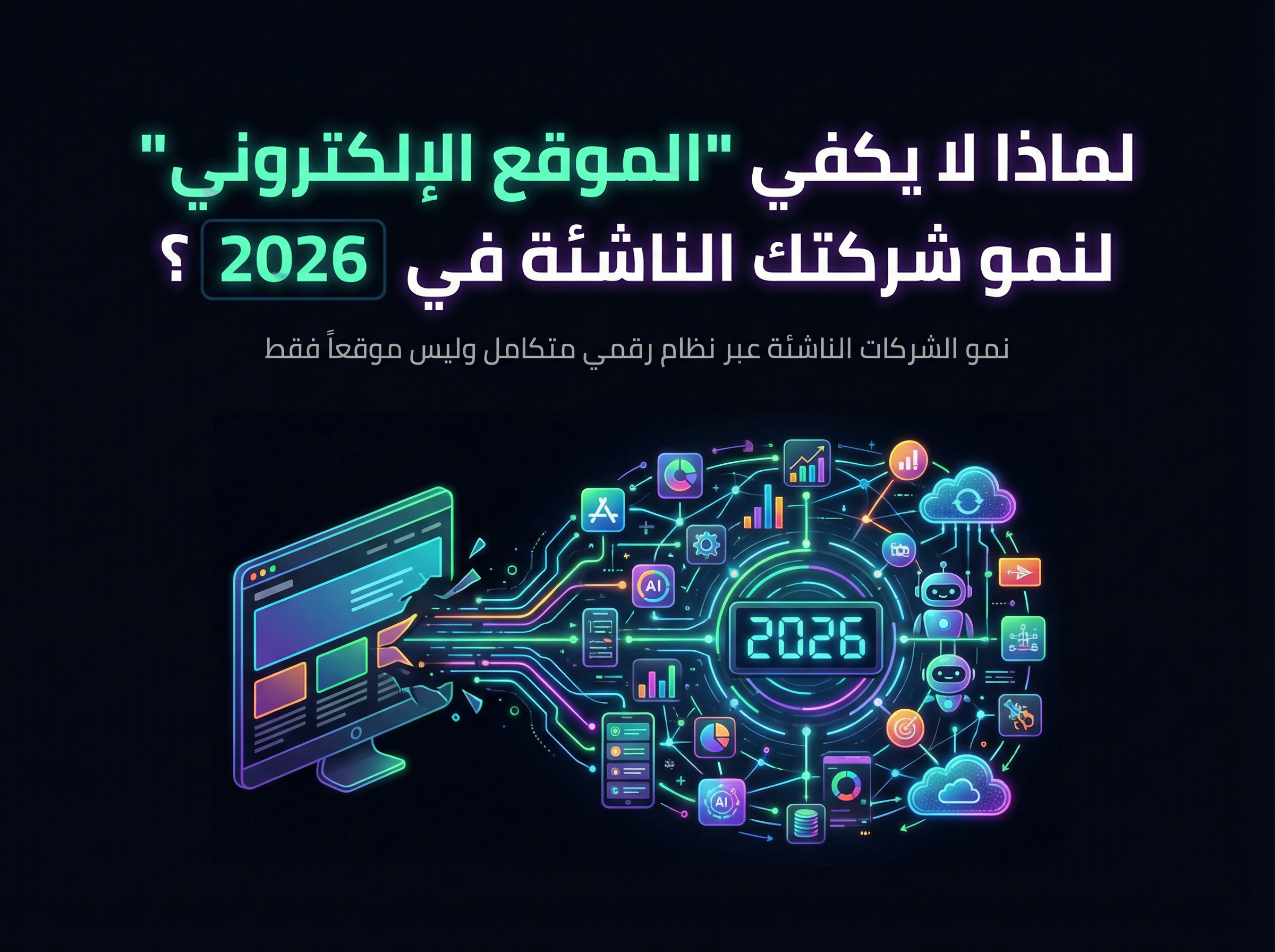
Why a “Website” Is No Longer Enough to Grow Your Startup in 2026
The shift from a digital storefront to an integrated system that drives the business
In 2026, I believe a website on its own is no longer enough for your startup. Why? Quite simply, it is no longer the centre of the customer journey, nor the sole engine of growth. It has become just one touchpoint within a far more complex system, one that spans multiple channels, vast data flows and the product itself, which should become a self-sustaining growth engine. That is what I have seen very clearly.
1. From Website to Growth System
I remember well that in 2010, owning a professional website was enough to feel you had a strong “presence” in the market. In 2026, though, the question has changed completely. It is no longer simply: do you have a website? What matters now is: have you built an integrated system that connects your website to your product, your marketing channels and your data?
-
Operational rigour: The game has changed. We are no longer talking about mere “digital presence” but about genuine “operational rigour”. In my experience, investors today look for crystal-clear sales cycles. They want a customer journey that can be measured precisely, and a direct, visible link between revenue and each channel.
-
The complexity of the B2B journey: And it is complex. The average buying journey runs to 211 days, during which the customer passes through 76 touchpoints before completing a purchase. That makes me see the website as one short scene in a very long film.
-
The illusion of a website that sells by itself: Even in lower-value sectors, I see the number of impressions and touchpoints needed to close a deal rising steadily. That makes the idea of a website selling on its own a “dangerous illusion” we need to move past.
2. A More Complex Customer Journey: The Website Is Just One Touchpoint
Let me be clear: customers no longer visit your website to buy straight away. It goes much further than that. They circle around you several times, researching and comparing, before they decide to show up in your CRM. It is a complex journey.
-
Touchpoints: On average, a B2B buyer uses ten different channels to engage, and 42% of them use more than 11 touchpoints. This shows just how fragmented attention is, and why you need an integrated ecosystem.
-
Positive fragmentation: Companies need, on average, 62 interactions across 3.5 different channels (such as the website, email, social media, content and the product itself) before closing a deal. I see this as “positive” fragmentation, because it reflects how deeply buyers research.
-
More decision-makers: Buying groups today include 6–10 people, each with their own concerns and criteria. In my view, this reduces the traditional website to a simple “brochure” that is nowhere near enough to influence all of them.
3. From the Traditional Funnel to Growth Loops
The old marketing logic, which relies on attracting traffic, converting it into leads and finally into sales, no longer holds up in 2026. Simply put, we have moved beyond it.
-
Growth Loops: Competition today revolves around building a product that can drive its own distribution. The idea is that customers themselves become a genuine source of new customers. That is the heart of the game now.
-
The website as fuel: In my experience, the marketing funnel has not been abolished entirely, but its role has changed: it now acts as “fuel” that sparks the growth loops inside the product. It is not the end, but the beginning.
-
Product-Led Growth (PLG): I can clearly see the website shifting from being the customer's final stop to a key conversion point into the product experience itself, whether through a freemium model or a free trial.
4. PLG in 2026: The Product Is the Engine
In my experience, companies that succeed in making the product their main acquisition channel stand out in two important ways: a faster time to value and a lower customer acquisition cost (CAC). That is absolutely vital.
-
The website's new job: As I see it, its role now centres on setting the right expectations, making the product's real value clear and removing any concerns the user might have before they enter the product itself.
-
New success metrics: Success metrics have changed and become far more product-focused. They now look like this:
-
Activation: reaching the first moment of value the user actually feels.
-
Retention: how long users keep using the product.
-
The referral loop: simply, the number of invitations each user generates for the product.
-
5. The Digital Ecosystem: Four Layers
In 2026, I believe a startup essentially needs to build an integrated digital system made up of four tightly connected layers, and this is vital to its success.
-
Channels Layer: There must be real coordination between the website, email and social media. Our messaging must be consistent, and there must be a single tracking system. I see this as essential.
-
Content Layer: I have found that buyers consume 13 pieces of content on average (8 from the vendor and 5 from third parties) before they even start talking to the sales team. That shows how much content matters.
-
Data Layer: Here we need a robust data infrastructure, one that links website visits to in-product user behaviour and to advertising channels. That integration is what gives us the full picture.
-
Product & Activation Layer: The product needs built-in acquisition mechanisms such as invitations, sharing and integrations. This turns the website into an entry point rather than the final destination.
6. The Maturing Startup Ecosystem in 2026
In 2026, I am seeing a fundamental shift in the startup ecosystem. We have moved from a mindset of “hype” and noise to one of “operational efficiency”. In my experience, successful companies now behave like complex, interconnected “systems”, much like universities, large corporations or even government bodies.
-
Technical excellence: I believe specialised AI and data analytics are no longer add-on features. They are now used at the core to build connected, effective growth loops. That is where real excellence lies.
-
The risk of falling behind: Here I see a clear warning. Companies that stop at the “beautiful website” stage will find themselves out of the game entirely. Competitors today are building integrated PLG systems and automating customer journeys. That is the reality.
7. What Does This Mean for You as a Founder in 2026?
For you as a founder in 2026, I believe designing your digital ecosystem should revolve around asking new and entirely different questions.
-
In my experience, these are the key questions to ask yourself: how can customers move towards discovering your product with the least possible friction?
-
Where exactly are the main points of friction in their journey across your different channels?
-
What is the core growth loop your company relies on: referrals, content or data?
-
And most importantly, how do you connect all this data to make grounded, well-considered decisions instead of relying on gut feeling alone?
Conclusion
To sum up, I believe the website is not dead in 2026, but it is simply no longer enough on its own.